
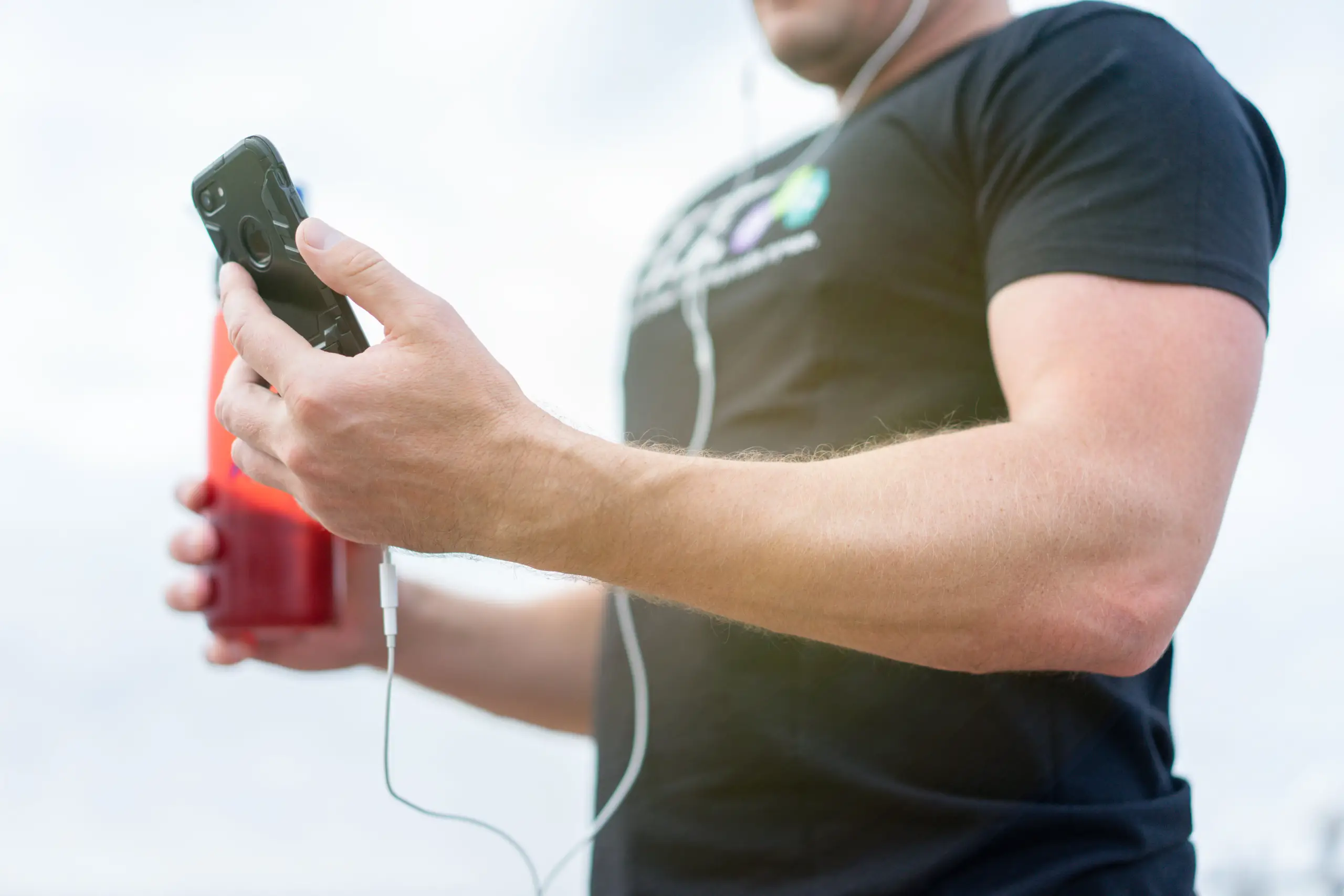
There are two kinds of runners in this world: the ones who wouldn't dream of leaving the house without their phone, and the ones who see a run as the one hour of the day when nobody can reach them. I'm firmly in the first camp, although I've had the odd run in the second.
With the evenings now dark, it's a question worth thinking about. Does your phone make your run better, worse, or a bit of both?
There's an important distinction here. Carrying your phone isn't the same as using it throughout your run. Listening to music, checking a route, answering messages and taking calls are very different things. So what does the research actually tell us?
The case for music
Let's start with the good news for headphone fans.
A major review of the evidence, Effects of Music in Exercise and Sport: A Meta-Analytic Review (opens in a new tab), was published in Psychological Bulletin in 2020 by Peter Terry and colleagues, including Costas Karageorghis of Brunel University London, one of the leading researchers in the field. They brought together 139 studies involving 3,599 participants.
Across those studies, music was associated with more positive feelings during exercise, better physical performance and lower perceived exertion. In other words, people tended to enjoy exercise more, perform slightly better and find the effort a little easier. The review also found a small improvement in physiological efficiency, measured through oxygen consumption.
Overall, music made no statistically significant difference to heart rate.
Faster-tempo music tended to produce greater performance benefits than slow-to-medium-tempo music, although the effects varied between studies and individuals.
The benefits aren't enormous, and the research covers many types of exercise, not just running. But for many of us, enjoying a run more is reason enough to put together a playlist. If music helps you get out of the door and makes the miles feel easier, the evidence is broadly on your side.
The case against distractions
Music is only one thing your phone does, though.
A smaller study by Michael Rebold and colleagues at Kent State University in the US, The Impact of Cell Phone Use on the Intensity and Liking of a Bout of Treadmill Exercise (opens in a new tab), published in 2015, looked at four different 30-minute treadmill sessions.
Forty-four young adults completed sessions while listening to music, texting, talking on the phone and exercising without access to their phones.
Music came out on top. Participants moved faster on average, had a higher heart rate and enjoyed the session more.
Texting and talking, by contrast, reduced treadmill speed compared with exercising without a phone. Talking made the session more enjoyable than having no phone, but it still slowed people down. Texting didn't significantly improve enjoyment.
The researchers suggested that splitting attention between exercise and another task may reduce how hard people work. It's an interesting finding, although the study was small, involved young adults and took place on treadmills rather than outdoors.
It doesn't prove that answering a message will slow every runner down. Nor does it mean carrying a phone is a problem in itself. There's a big difference between having a phone in your pocket and stopping to reply to a message halfway through a run.
What about running outdoors?
This is where the question gets a little more complicated.
The music research mostly looks at exercise in controlled settings. The phone study wasn't designed to measure road awareness, navigation or safety in the dark. Neither tells us whether running with headphones is safe in every environment.
When you're running near traffic, crossing roads or sharing a busy path, being aware of what's happening around you matters. Depending on their design, volume and the noise around you, headphones can make it harder to hear approaching vehicles, cyclists or other people.
That doesn't mean everyone needs to run in silence. It means being deliberate about how you listen.
Keep the volume at a level that allows you to remain aware of your surroundings. Consider open-ear or bone-conduction headphones, and take your headphones off on busier or more hazardous stretches. No headphone design guarantees that you'll hear every approaching hazard.
Your route matters, too. A quiet, familiar park path is very different from a busy road junction in the dark.
UK Athletics' running safety guidance (opens in a new tab) also recommends thinking about whether headphones increase the risk on your chosen route. It suggests considering bone-conduction headphones, letting someone know where you're running and when you expect to return, and sharing your intended route where possible.
My take
For me, the answer isn't phone or no phone. It's what you use it for.
I rarely run without mine. It sits in a chest strap holder, out of the way but there if I need it, and I'd always take it in the darker months, when being able to contact someone, find my way on an unfamiliar route or use the emergency features feels important. That's my practical judgement rather than something the studies above prove.
What I listen to varies. I must admit that when a song I love comes on, it gives me a real boost, which fits neatly with what the research found. Show tunes and 90s hits do the job nicely. A lot of the time, though, I'm listening to podcasts, which I can drift in and out of without losing the thread. Audiobooks I save for very rare occasions, because I find I miss whole chunks of the story whenever my mind wanders onto the run.
On the occasions I've left my phone at home, it has felt amazingly freeing, and I'd recommend trying it. I'll also admit I feel a little lost without it. My watch has its own GPS, but part of me never quite trusts it unless it's connected to my phone, which probably says more about me than the technology.
What I don't do is use the run as a chance to catch up on messages. I very rarely stop to text or answer a call, and I don't really need a study to tell me that splitting my attention between a screen and the run won't do my pace any favours. It's still nice to see the research back that up. If you're constantly replying to messages or getting drawn into conversations, your attention is on something other than the run, and that seems to show in how hard you work.
So music and podcasts are worth it if they help. If an upbeat playlist makes the miles more enjoyable, go for it. Just think about where you're running and make sure you can stay aware of what's around you.
And every so often, try a run with nothing in your ears at all. You might enjoy the quiet, notice more of your surroundings or simply tune in to how the run feels.
Or, better still, run with someone.
The phone study found that talking made exercise more enjoyable, even though participants moved more slowly, and that matches my own experience. When I run with other people, I find my truest easy pace. It often feels too slow, but knowing I can hold a comfortable conversation without struggling for breath reminds me that this is exactly what easy running is supposed to feel like.
That's one of the ideas behind Run Love Sprint: helping people find running partners, social runs and a community to share the miles with.
You don't always need another playlist. Sometimes, a good conversation is enough.
This article is for general information. Take care when using headphones outdoors, stay aware of your surroundings, and choose equipment and routes appropriate to the conditions.


